
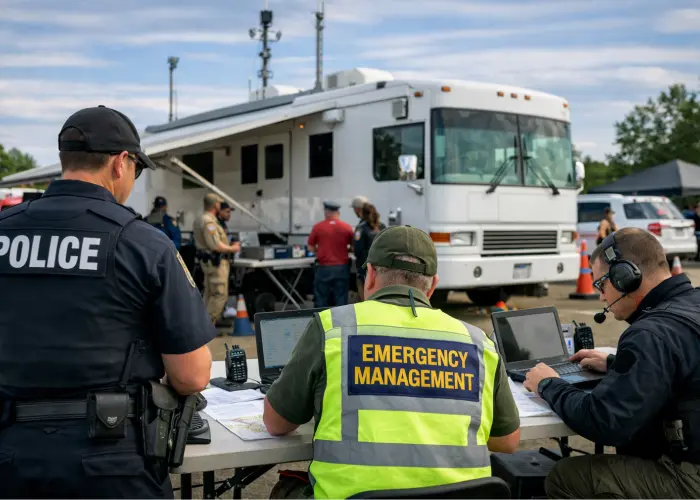
Spring marks the start of field operations season. Deployments increase. Exercises are scheduled. Planned events and training operations move from planning to execution.
For many agencies, this is also when connectivity challenges become visible.
Connectivity that works well during routine, day to day operations does not always perform the same way when operations expand, move, or surge. Spring is the right time to evaluate readiness before operational tempo increases.
From Routine Operations to Field Conditions
During slower months, connectivity often supports fixed locations, familiar workflows, and predictable demand. Field season changes those conditions quickly.
Spring operations often involve:
- Mobile command posts and temporary sites
- Multi agency exercises and joint operations
- Planned public events that increase network demand
- Weather driven responses and rapid deployments
Each scenario adds complexity. More users. More devices. More data. More movement.
Connectivity that performs well in a station or office environment can struggle when deployed in the field.
Scaling From Day to Day Operations to Surge Response
One of the most common challenges agencies face is scaling connectivity.
Day to day operations may require limited bandwidth, fewer users, and minimal redundancy. Surge operations introduce very different requirements.
During deployments or exercises, agencies often need:
- Rapid setup in unfamiliar or temporary locations
- Increased bandwidth for video, mapping, and situational awareness tools
- Multiple network paths to maintain continuity
- The ability to prioritize mission critical traffic
Without flexible connectivity, agencies may experience slow performance, unstable connections, or outages when demand increases.
How Spring Activity Reveals Gaps
Training exercises and planned events are valuable because they highlight issues before real incidents occur.
Common gaps that surface include:
- Coverage limitations in rural or temporary locations
- Single points of failure without backup connectivity
- Equipment that cannot be redeployed quickly
Networks that cannot support additional users or applications
These issues are often hidden during routine operations and only become clear during active field use.
What to Evaluate Before Field Season Peaks
Spring is the ideal time to ask a few key questions:
- Can connectivity be deployed quickly to new locations?
- Is there sufficient capacity to support surge operations?
- Is the network resilient if a primary connection fails?
- Can multiple agencies and devices be supported at once?
If any of these answers are uncertain, now is the time to address them.
Connectivity Should Support the Mission
Reliable communications are essential to effective field operations. Connectivity is no longer just a technical consideration. It directly affects situational awareness, coordination, and response effectiveness. Preparing early helps ensure that as deployments increase and operations scale, connectivity supports the mission instead of limiting it. Spring readiness is about more than equipment checks. It is about ensuring your connectivity strategy is built for real world field operations and not just routine conditions.
PEAKE helps agencies prepare before tempo increases by designing and supporting connectivity solutions built for mobility, scale, and resilience. From rapidly deployable communications to mission-ready network support, PEAKE ensures teams stay connected when operations expand, environments change, and stakes are high.